What Information Does a Supplement Manufacturer Need Before Quoting?
Direct answer
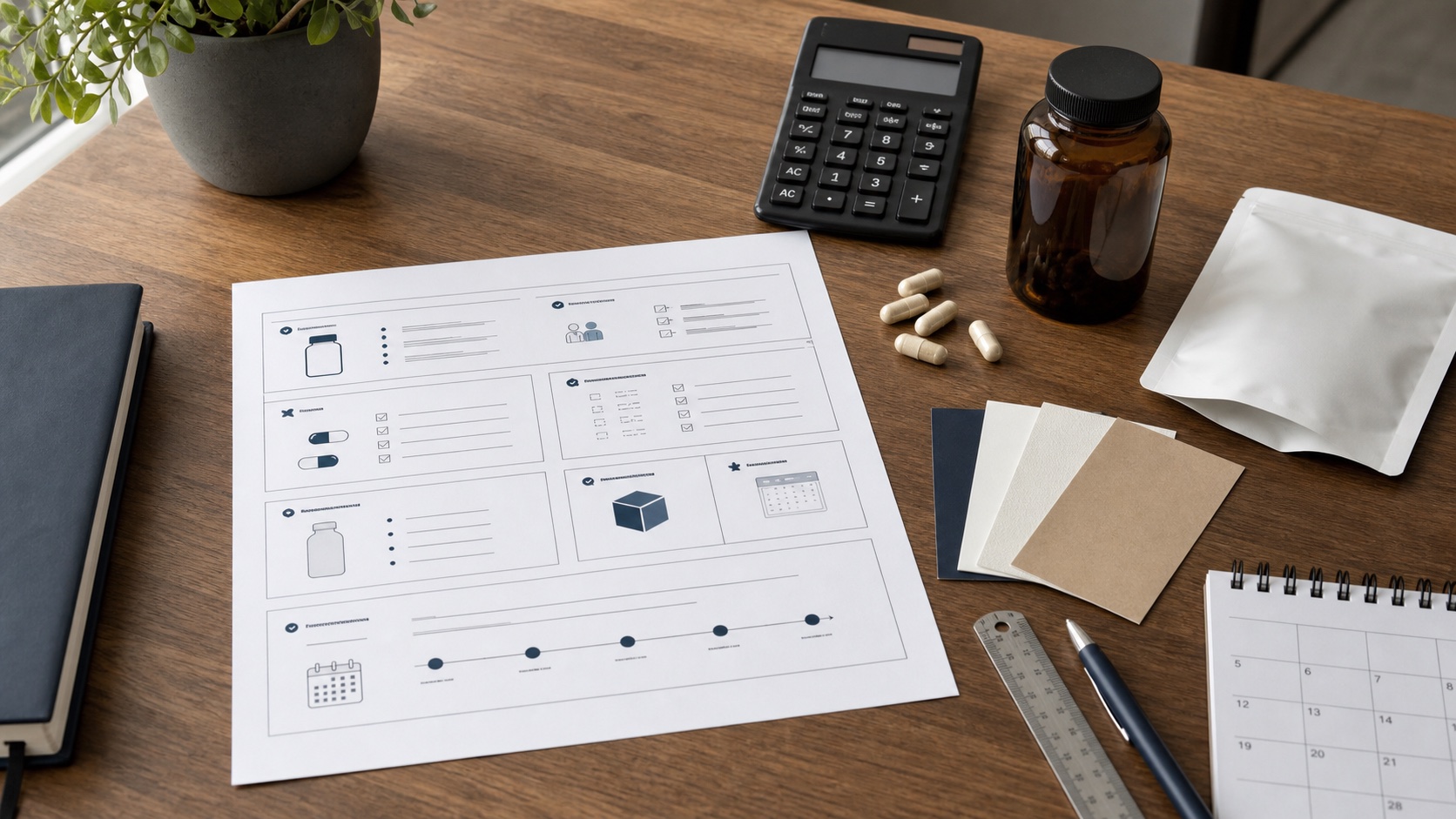
Before a supplement manufacturer can provide a usable quote, the brand should define six inputs: the target market, dosage form, formula status, realistic first-order quantity, packaging format and target launch date. These inputs determine the production process, development work, ingredient and packaging minimums, testing scope, document pathway and timeline. Without them, a quoted unit price is usually only a provisional assumption—not a comparable project cost.
Why incomplete supplement RFQs produce misleading quotes
A supplement RFQ is incomplete when suppliers must guess the formula, serving size, pack configuration, order quantity, testing scope or destination market. Different guesses create different projects, so the resulting unit prices cannot be compared reliably.
A request such as “Please quote a magnesium gummy” sounds specific, but it leaves most cost and feasibility decisions unresolved. The active dose may not fit the desired gummy weight. The brand may expect a vegan pectin base, a particular flavor system, a child-resistant closure or a market-specific testing package. Each assumption can change the line, development work, bill of materials and commercial minimum.
The purpose of an initial brief is not to finalize every technical detail. It is to remove the few uncertainties that would cause suppliers to quote fundamentally different manufacturing routes. A range is acceptable for early planning, provided the assumptions are written down and clearly labeled as provisional.
The six inputs required for an initial manufacturing review
| Project input | What to provide | Why it changes the quote |
|---|---|---|
| 1. Target market | Country or region of sale, channel and intended claims | Changes label review, documentation, responsible-party and import/export planning |
| 2. Dosage form | Gummy, capsule, tablet, powder, softgel, liquid or another format | Determines equipment, process, active capacity, development risk and minimum batch size |
| 3. Formula status | Stock formula, modified formula, complete formula or benchmark product | Defines how much formulation, sourcing, sampling, specification and testing work remains |
| 4. First-order quantity | A realistic range plus expected reorder volume | Affects line fit, ingredient purchasing, packaging minimums, setup cost and unit economics |
| 5. Packaging format | Pack count, bottle/pouch/sachet/blister/box, material and artwork status | Packaging MOQ, tooling and assembly can exceed the finished-product minimum |
| 6. Target launch date | Shelf date, hard approvals and whether the deadline is flexible | Defines the critical path for samples, materials, production, release and freight |
1–2. Target market and dosage form determine the route
The target market determines which product, label and business documents may be needed, while the dosage form determines which process and production line can physically make the product. These two decisions should be set before detailed formula costing begins.
For the target market, provide more than a country name. State whether the product will be sold through Amazon, retail, practitioners, distributors or a direct-to-consumer website, and list the principal claims under consideration. The manufacturer is not a substitute for the brand’s legal or regulatory adviser, but market context is necessary to plan labels, documents, testing and export support.
For the dosage form, include the target serving and any non-negotiable attributes: vegan, sugar-free, gelatin-free, allergen exclusions, capsule shell preference, powder flavor or liquid delivery format. A formula that fits two capsules may not fit one gummy or one small stick pack. The format should therefore be evaluated against the active load before the brand invests in packaging design.
- State the intended serving size and units per serving.
- Provide a benchmark product or sensory reference where possible.
- Identify ingredients or claims that are mandatory versus optional.
- Clarify whether the format or the formula has priority when capacity is limited.
3. Formula status defines the development scope
A stock formula, modified formula and fully custom formula should not be quoted as if they require the same work. The route affects development fees, sampling rounds, ingredient sourcing, specifications, testing and the point at which commercial pricing becomes firm.
A stock or private-label formula can shorten the path when the formula, ingredient sources, specifications and process already exist. A modified formula may appear simple but can require new flavor work, stability assessment or ingredient purchasing. A fully custom formula requires the clearest brief because the first quote may be a budget direction rather than a final production price.
If the formula is not complete, send the desired benefit, required actives, target dose, exclusions, preferred format and benchmark products. If it is complete, send ingredient forms and daily amounts—not only ingredient names. For standardized botanical extracts, branded ingredients or materials with variable assay, specify the potency basis used for the label claim.
4. A realistic quantity range reveals the actual MOQ bottleneck
The finished-unit MOQ is only one minimum. A project may also be constrained by the production batch, custom ingredient purchase, flavor or coating setup, printed packaging, testing cost or unused inventory. Brands should provide both an initial-order range and a reorder scenario.
“As low as possible” does not give a manufacturer enough information to choose a commercial route. A pilot quantity may favor a stock formula and standard packaging, while a larger and repeatable volume can justify custom ingredients, printed components or dedicated tooling.
Ask the supplier to separate the finished-product MOQ from the ingredient and packaging purchase minimums. If the order consumes only part of a material lot, confirm who pays for, owns, stores and eventually disposes of the remainder. A low finished-unit minimum can still create a high total exposure when excess packaging or ingredients are included.
5–6. Packaging and launch timing often control the critical path
Packaging can change component minimums, tooling, artwork requirements, assembly and lead time. The stated manufacturing lead time should therefore identify its starting condition—such as formula approval, artwork approval, deposit and material release—not simply count from the first inquiry.
For a first review, provide the primary container, count or fill weight, closure, label or print method, secondary box or display requirements and destination case configuration. If the packaging has not been selected, say so. Standard packaging plus a label may be the better validation route when demand is uncertain.
Work backward from the required shelf date. Include time for formula feasibility, sample iterations, specifications, label and artwork review, packaging proofing, long-lead materials, production scheduling, finished-product testing, document release, freight, customs and warehouse receiving. Ask each supplier which approvals must be complete before its quoted lead time begins.
How to make two supplement manufacturing quotes comparable
Before comparing unit prices, confirm that both suppliers are using the same formula and active-input basis, pack specification, order quantity, testing scope, Incoterm, delivery destination and lead-time starting condition.
A useful comparison separates recurring product cost from one-time charges and inventory exposure. The lowest quoted unit price is not necessarily the lowest-risk or lowest-cost project when critical items are excluded.
- Formula and raw-material assay assumptions, including any process or stability overage.
- Finished-product quantity, pack count and packaging specification.
- Included and excluded tests, retest policy and release documents.
- One-time development, sample, tooling, plate, mold or line-setup charges.
- Customer-owned excess ingredients or packaging and any storage charges.
- Incoterm, freight mode, destination, duties and customs responsibility.
- The exact approval event that starts the quoted production lead time.
Copy-and-paste initial project brief
Use the following brief to request an initial manufacturing feasibility review. A range is sufficient for the first pass; unknown items should be marked as open rather than silently assumed.
Latitude Nutra uses this information to screen suitable manufacturing routes before requesting detailed commercial responses. Capability, certifications, documentation, MOQ and terms must be confirmed with the specific manufacturing entity selected for the project.
- 1Target market and sales channel:
- 2Dosage form and target serving:
- 3Formula status and required actives:
- 4First-order quantity range and expected reorder:
- 5Packaging format, count/fill weight and artwork status:
- 6Target launch date and any hard approval deadlines:
- 7Required testing, claims, exclusions or certification expectations:
- 8Delivery destination and preferred shipping term, if known:
Sources and reference points
Requirements vary by product and market. Use the primary sources below and obtain project-specific advice where needed.
Reviewed by: Latitude Nutra Project Team
Last reviewed: 2026-07-21
Corrections or document updates: [email protected]
Ready to source your product?
Get a factory match and quote tailored to your market.