How to Choose a Supplement Manufacturing Route

Direct answer
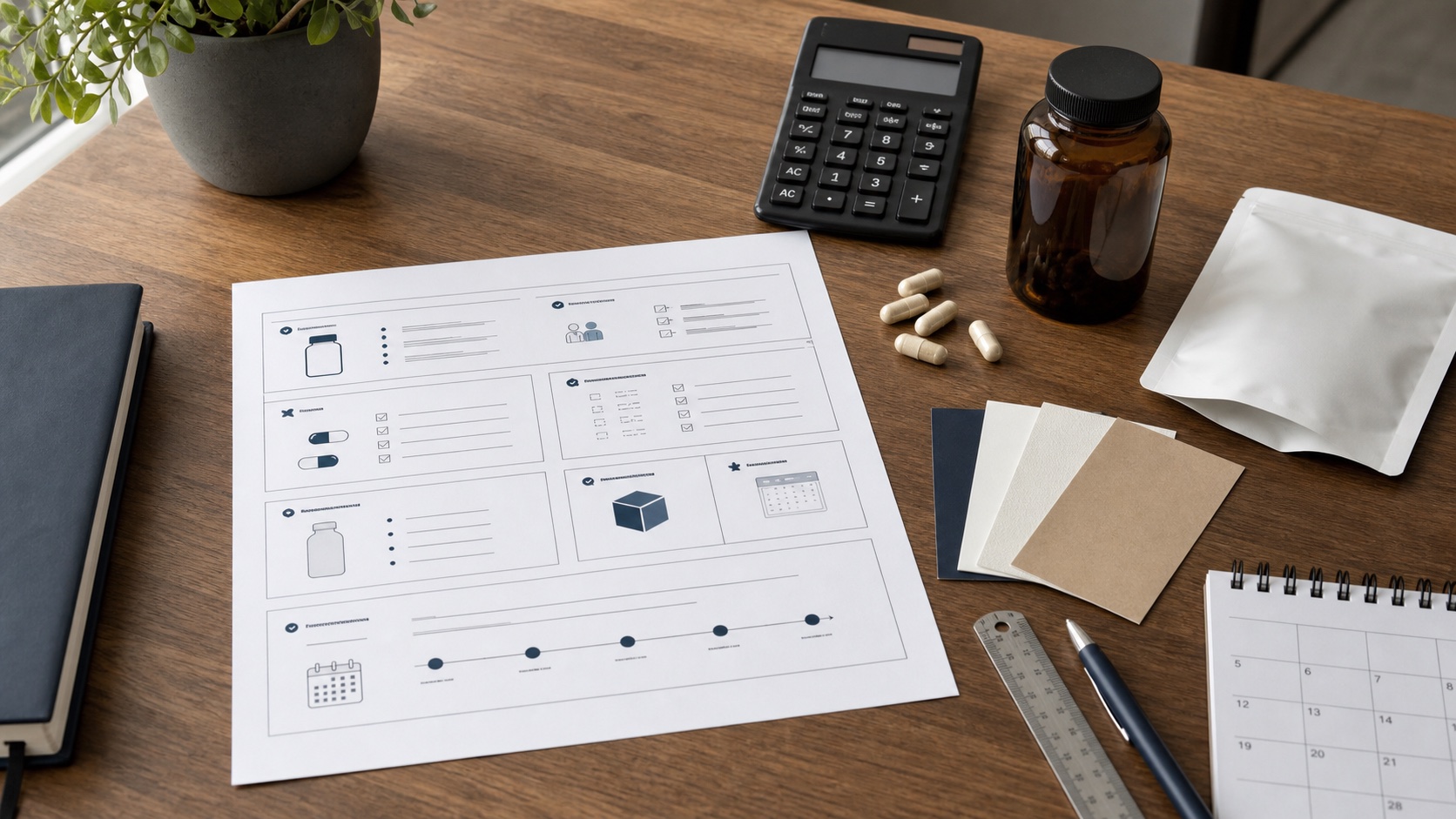
Choose a supplement manufacturing route by screening the project before ranking factories. Start with the target market, dose and serving, dosage form, formula maturity, initial and reorder quantities, packaging, testing scope and launch logistics. Then compare eligible manufacturers on process capability, entity-specific documents, total project exposure, communication and replenishment fit. No country or factory is universally best; the suitable route is the one that matches the complete product brief.
Why the manufacturing route should be chosen before the factory
A factory should be evaluated only after the project’s non-negotiable requirements are known. Otherwise brands tend to compare impressive brochures, certificate logos or headline MOQs without confirming whether the relevant facility can make, test, document and deliver the specific product.
The phrase “best supplement manufacturer” hides several different questions. A small brand validating a stock capsule for U.S. ecommerce has a different route from a retailer launching a custom gummy with printed pouches, or a practitioner brand that needs a detailed batch-release package. The facility that is commercially suitable for one brief may be technically or operationally unsuitable for another.
Latitude Nutra is structured around route evaluation rather than forcing every project into a single plant. That does not mean every project receives multiple viable offers. It means the project is screened first, unsuitable directions are removed, and the selected manufacturing entity is then verified for capability, documents and terms.
Eight variables that can change the manufacturing route
| Variable | Question to answer | Route impact |
|---|---|---|
| Target market | Where and through which channel will it be sold? | Label, documentation, responsible-party and import/export pathway |
| Dose and serving | How much of each active is required per day? | Unit weight, capsule count, scoop size and process feasibility |
| Dosage form | Gummy, capsule, powder, softgel, tablet or liquid? | Equipment, tooling, technical experience and stability controls |
| Formula maturity | Stock, modified, benchmarked or fully custom? | Development, sourcing, sampling and testing work |
| Order profile | What are the first order and realistic reorder? | Line fit, purchasing quantities, setup cost and unit economics |
| Packaging | What contains, protects and presents the product? | Component MOQ, tooling, artwork, assembly and freight cube |
| Testing scope | What must be tested and released? | Fixed batch cost, sample size, laboratory timing and documents |
| Launch and logistics | When and where must finished goods arrive? | Critical path, production slot, freight mode and buffer |
Screen 1: market and entity fit
The first screen is not the country name on the brochure; it is the legal manufacturing entity, actual production address and document pathway for the intended destination market.
Confirm which entity will manufacture, invoice and appear on relevant production or quality documents. A sales office, brand owner, certificate holder and physical production facility can be different entities. The relationship is not automatically a problem, but it must be understood before relying on certificates or batch records.
For U.S. dietary supplements, manufacturers are subject to applicable food-facility and dietary supplement current good manufacturing practice requirements; the FDA does not issue a general “FDA-approved manufacturer” certificate for dietary supplements. For other markets, notification, importer, language, ingredient and product-category requirements vary. The brand should obtain market-specific advice where necessary and avoid treating a factory logo as proof of product compliance.
- Legal name and physical address of the manufacturing facility.
- Entity that holds each licence, registration or certificate.
- Scope, status and validity of the document.
- Entity that signs specifications, COAs and release records.
- Importer, responsible-party and destination-market responsibilities.
Screen 2: product and process capability
Capability means more than listing a dosage form. The relevant line must be able to handle the active load, material properties, unit size, sensory target, packaging system and control strategy required by the formula.
Ask which line and process will be used, whether the formula is already proven on that process, and which technical risks remain open. For gummies, active load, heat exposure, flavor, texture and moisture are linked. For powders, flow, bulk density, dispersibility, flavor and moisture control influence both formula and packaging. For capsules, fill weight, density, shell selection and capsule count determine whether the intended serving is practical.
Sampling should resolve named acceptance criteria rather than produce an attractive but undefined sample. Write down the target appearance, flavor, texture, dimensions, fill weight, active basis and packaging configuration. If the project uses branded or standardized ingredients, confirm the exact grade and assay basis used for costing and specifications.
Screen 3: commercial fit and total project exposure
Compare total project exposure, not only finished-unit price. Include formula and raw-material assumptions, testing, development, setup, tooling, packaging, unused inventory, freight, duties and the cost of an inflexible reorder route.
Separate recurring costs from one-time charges. Then model the initial order and at least one realistic reorder. A route that is acceptable for validation may become expensive or slow at scale; a high-volume route may expose a new brand to unnecessary inventory before demand is proven.
| Cost layer | What to clarify | Common hidden exposure |
|---|---|---|
| Formula basis | Label claim, assay, overage and expected yield | Different input assumptions create different costs |
| Production MOQ | Minimum batch and usable finished quantity | Unused bulk or partial filling |
| Ingredients | Purchase lots and ownership of the balance | Customer-funded excess inventory |
| Testing | Included panel, external fees and retests | Fixed cost omitted from the unit price |
| Packaging | Component MOQ, tooling, printing and assembly | Packaging bought for more units than the order |
| Logistics | Incoterm, freight, insurance, duties and destination | A factory-gate quote compared with delivered cost |
Screen 4: operational and replenishment fit
A technically capable factory can still be the wrong operational route if sample cycles, approvals, communication, production windows, batch release or replenishment timing do not match the brand’s launch and inventory model.
Ask for a milestone-based timeline: feasibility review, formula freeze, sample approval, specification approval, artwork approval, deposit, long-lead material release, production slot, testing, document release and freight. A stated lead time is incomplete unless its starting condition is named.
Consider who coordinates the handoffs. Formula, packaging, label, documents and logistics often have different owners. A single coordination layer can reduce information loss, but accountability should still be written down. The brand should know who approves changes, who maintains the master specification and who communicates deviations before release.
How to evaluate U.S. and Asian manufacturing routes
Do not choose an origin from a generic cost or quality stereotype. Evaluate the specific entity and project against the same market, technical, commercial and operational criteria.
A U.S. route may be evaluated when domestic production, local replenishment or a selected stock-formula path is important. A China route may be evaluated for particular dosage-form capabilities, supply-chain depth or scaled production. Hong Kong or Singapore routes may be relevant when their specific entity, facility, product category, document pathway or logistics fit the brief. These are screening directions, not guaranteed advantages.
For every origin, verify the actual manufacturing site, current scope of licences or certifications, product capability, batch documents, commercial assumptions and delivery responsibilities. Country of origin does not replace facility qualification, and the availability of a document for one entity or product does not guarantee its availability for another.
A practical route-selection sequence
Latitude Nutra can perform an initial manufacturing feasibility review from a rough brief. The result is a list of open questions and potentially suitable route directions, not a guarantee that every origin or facility will accept the project.
- 1Write the six-input project brief: market, format, formula status, quantity, packaging and launch date.
- 2Add non-negotiable claims, exclusions, tests, documents and delivery requirements.
- 3Remove routes that fail a market, technical or timeline requirement.
- 4Request comparable assumptions from the remaining manufacturing entities.
- 5Compare total project exposure for the initial order and reorder—not only unit price.
- 6Run samples against written acceptance criteria and freeze specifications before production.
- 7Confirm the legal entity, production address, documents, milestone timeline and change-control owner.
Sources and reference points
Requirements vary by product and market. Use the primary sources below and obtain project-specific advice where needed.
Reviewed by: Latitude Nutra Project Team
Last reviewed: 2026-07-21
Corrections or document updates: [email protected]
Ready to source your product?
Get a factory match and quote tailored to your market.